

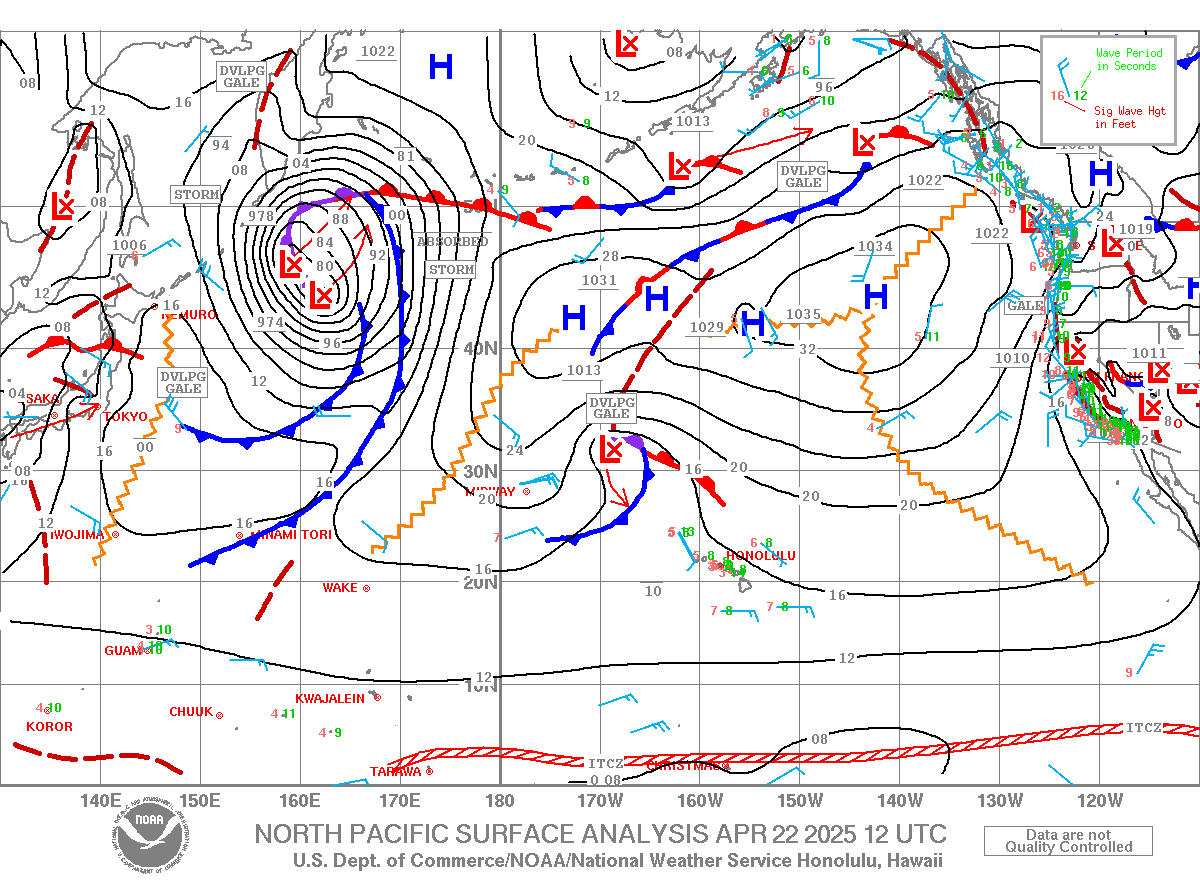
Weather Map: Global weather patterns affect our local weather. Distant storms produce surf, and massive pressure systems create our winds. We can see these features on the Weather Map. Here is today’s weather map:
Tides on Maui: In general Tides only vary about 2 feet in range, While this is a small amount it makes a big difference because the water is shallow in many places and the reef can get close to the surface or exposed at low tides. At high tides, beaches become narrow and will have more shorebreak. Pay attention to the tide times for a better safer session. For more detailed information about tides go to our Maui Tides Page.
Rain Radar: The rain radar is the best way to see if there is bad weather coming especially heavy rains. Rain showers are not only wet, they can cause flooding on land, and rain squalls can cause strong wind gusts. Severe storms may create lightning as well. So it is always prudent to pay attention to the rain radar.
Changing of the Seasons: Maui has super consistent weather, but we still have seasons here. The Surfing Season is coming and you will notice things changing. Each season has a character and a rhythm, so be prepared to adjust your approach and technique accordingly. To read more about the different weather by season and by month, Go to our Maui Weather Page..
Oceans are not like Lakes or Rivers: If you are new to ocean sailing then you should get a lesson on Ocean Sailing from one of our Action Sports Maui instructors. There are many common pitfalls and basic survival techniques that you will want to learn before getting yourself into trouble. Talk to Suzie about our “Ocean Rider 101 class”. Read more about ocean safety on our Ocean Safety Page..
Strong Wind Warning: Maui has a lot more strong wind days than most other locations. Many people have not kited in strong winds before. Riding in strong winds requires an adapted technique and specialty equipment. If you came to Maui with only large kite sizes then there is a good chance that your kite will be too big some of the time. Do not go out overpowered, you are taking a risk with your own safety but you put other people at risk as well. So always ask one of our local instructors about your kite size choice if you are in any doubt. Your kite should never be significantly larger than the other kites on the water. Note that most of the local riders will make better-informed choices on the right kite size for the local conditions. If necessary you will need to rent a smaller kite And/or get a lesson on riding a smaller kite in strong winds. If you have never ridden a small kite size before, then get a lesson from one of our Instructors. Ask Suzie about our High-Wind 101 Lesson.
Hurricane Season: Hurricanes are most likely to occur July through December in Hawaii. Hurricanes bring severe bad weather, flooding rain, and potentially devastatingly strong winds. The passing of a Hurricane may last days or up to a week or more. The Hurricanes usually develop far away in the eastern Pacific and we generally get several days or more warning of their approach. So there is usually time to make preparations and even evacuate if necessary. Many Hurricanes come close to Hawaii but are just too far away to have a severe effect, This near-miss scenario, and repeated canceled warnings, can give some people a false sense of security. Until one does hit, and then they may be unprepared. Here’s the link to the National Hurricane Center (NHC)
Tsunami Waves: The Hawaiian Islands are susceptible to tsunamis. Tsunamis are a series of large devastating waves caused by geological events, like earthquakes and undersea landslides. In the event of an undersea earthquake, large sections of sea-floor can suddenly shift causing a huge displacement of water. Unlike regular waves are an accumulation of smaller wind waves. Tsunamis are much larger and will breach the shoreline and inundate the land. For updated info on Tsunamis go to U.S. Tsunami Warning System
Climate Change Maui: There is a lot of confusion about climate change. There are anthropogenic (man-made) factors that affect climate, like greenhouse gases, deforestation, and pollution. This is a worldwide problem but has to be managed locally as well. Reduce our carbon footprint using renewable resources like solar and wind energy, as well as recycling and reusing materials rather than throwing materials away after a single use. Also being mindful of not causing harm to the ecosystem by overusing toxic agricultural chemicals. Also eating less meat (reduces greenhouse gases and deforestation) would be a major step in slowing
Global Warming. For More Information, including How climate change affects Maui, Beach Loss, & Coral Reef Destruction and Degradation, Go to Our Climate Change Maui page
CAUTION: Always be sure of your abilities, training, and local knowledge before you attempt to kite, sail or surf. If in doubt don’t go out!
Maui Factor: Maui is not like other places. Maui is perhaps more extreme than most people are expecting. Always treat Nature and the elements here with respect. Be humble and do not underestimate the weather. Mother Nature is the boss, so do not push your luck no matter how long you have waited to sail or surf here. There are going to be days when you should NOT go out. There will always be conditions too tough even for the biggest expert, never forget that. Maui factor usually also means that you will not be as good as you think you are, the first time you ride here. So start conservatively and take the time to learn about local conditions. Pay your dues, be respectful, and be prepared to be humbled. With the right attitude and approach, you will better appreciate, adapt to, and ultimately enjoy the uniqueness that Maui has to offer. **Read More Local Information Below at the Bottom of this Page.
KITE SAFE PRO-TIPS: “BEWARE OF OFFSHORE WIND”
Offshore wind is inherently dangerous: Never kite in off-shore wind if you have no way to return to shore. For Safety, you always need to be able to drift downwind to a point on land. Offshore winds in a bay: a small bay that is offshore at the launch, but has another shore with onshore wind, that can be easily reached by downwind body dragging is sometimes acceptable. Never ride in pure offshore winds without a dedicated support boat active on site. Launching in offshore winds is very difficult as winds are usually very gusty.
Offshore winds are deceptive; the wind at the shore is usually very different from the wind on the water. People often severely underestimate the wind strength in offshore winds. When you launch/ride in offshore winds there is a greater difficulty returning to the beach afterward. Getting back to the beach may become impossible!
Have a Plan Before You Launch: Always consider what will happen when your gear breaks or you lose your board or kite. What is your plan when gear failure happens? What is your plan when the wind increases/decreases? What is your plan when there is no one to assist you? What is your plan when you get tired/cold/injured? If you do not have a plan, or if you do not know the answers to these basic questions, then we strongly suggest that you get a lesson from one of our local instructors to give you the skills to become self-sufficient, independent, and able to kite responsibly and “autonomously” in the local Maui Conditions.
Shorebreak Warning: Watch out for shorebreak. There is a high risk of serious injury or death. Especially when the tide is high and the swell is up. There tends to be more shorebreak. Shore break is waves breaking into the shoreline, and they can be especially dangerous even when they are small. Take care when crossing through the shore break, and do not linger there. Get in and get out quickly, do not lose your footing, and definitely, do not drop your kite in the shorebreak. For More Infor on ShoreBreaks go to our Shore Break Warning Page.
Maui Surf Report: The Maui Surf Report has far too much information to fit here so it has its very own page. So if you need the latest surf info, like to learn, or are just curious then please check it out. For more detailed Surf Information go to our Maui Surf Report Page.
Maui Wind Report: The Maui Wind Report has far too much information to fit here so it has its very own page. So if you need all the detailed Maui Wind Info, like to learn, or are just curious then please check it out. For more detailed wind information go to our Maui Wind Report Page.